Transmission Line Easement Guidelines
What is an easement?
An easement is an interest in land that allows one party to use the property owned by another party. It defines the rights, restrictions and permitted activities within the easement area.
Evergy uses easements to construct, operate, maintain and access electric facilities. These easements are critical to ensuring safe, reliable power delivery and maintaining access for maintenance and emergency response.
Before making any significant change within the easement area, Evergy’s written consent is required. This ensures we can continue to safely operate and maintain the electrical line.
Examples include but are not limited to: constructing playhouses, planting trees or changing grades. Moving forward without approval can create safety hazards and may require removal at the owner’s expense.
All easement documents are public records and can be found at the local county Register/Recorder of Deeds offices. In some cases, older easements obtained through condemnation will be found only in the local court records.
Submitting Development Plans for Review and Approval
When planning work within Evergy easements, please request input from us as early as possible.
Development plans and questions can be submitted to encroachments@evergy.com.
Evergy strives to respond as soon as possible to such requests, but the review may take several months depending upon weather, workload and complexity of the requested exception.
The following examples highlight common areas of coordination within Evergy transmission line easements. This is not considered an exhaustive list. These examples apply to proposed new activities or modifications within the easement and may not apply to existing features or conditions. They are provided as general guidance to support planning and early coordination within Evergy transmission line easements and do not constitute review or approval by Evergy. Evergy review and approval are required for proposed modifications to help ensure the safe and reliable operation of the transmission system.
Access and Future Installations
Evergy crews may need to access transmission structures at anytime for repairs, maintenance or to restore power during an outage. Space must be available for equipment setup and for the installation of new poles at different locations if necessary.
Please do not make assumptions regarding our ability to access and install structures within the easement. Instead, contact Evergy to review proposed changes.
Overhead Transmission Line Clearance Safety
To ensure safe construction, adequate clearances must be maintained between Evergy’s transmission line structures and all construction equipment and personnel. The sections below offer guidance for commonly proposed activities within Evergy easements. Contact Evergy to confirm what clearance requirements are applicable to your property.
Generally, an above ground object that is not considered permanent, has a non-accessible roof and is less than 10 feet tall. They may be permitted after review as long as it does not hinder or unnecessarily restrict Evergy’s access. Some items inherently increase risk and cannot be permitted.
Examples of prohibited above ground objects regardless of height:
- Buildings
- Enclosures (including sheds)
- Fuel storage
- Flammable substance storage
- Explosives storage
- Diving boards
- Trampolines
- Swimming pools and pool decks
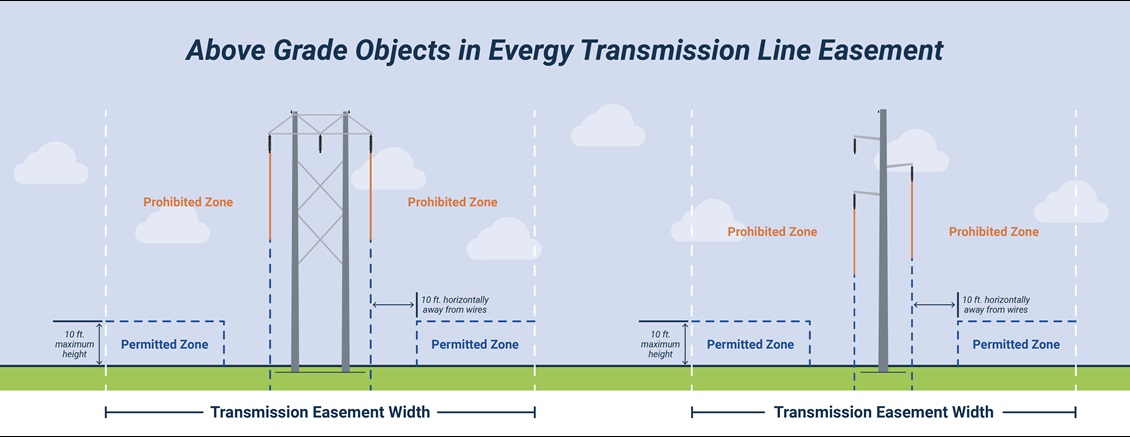
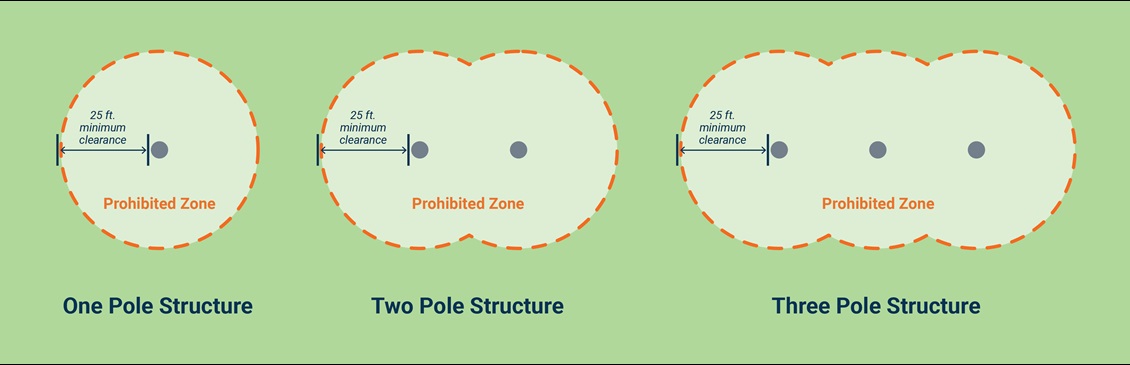
Minor ground modifications may be completed by the property owner. These are defined as anything with less than one foot elevation change. Ground modifications exceeding one foot elevation change must be reviewed and approved by Evergy. Generally, there is a minimum 25 foot do not disturb zone around all structures, except for farming.
Examples of prohibited ground modifications:
- Significant grading changes (greater than +/- one foot)
- Detention ponds or sediment basins
- Retaining walls crossing the easement
- Earthwork that removes large equipment and vehicle access to existing poles or anchors
- Earthwork that creates slopes steeper than four horizontal feet for every one vertical foot (4h:1v)
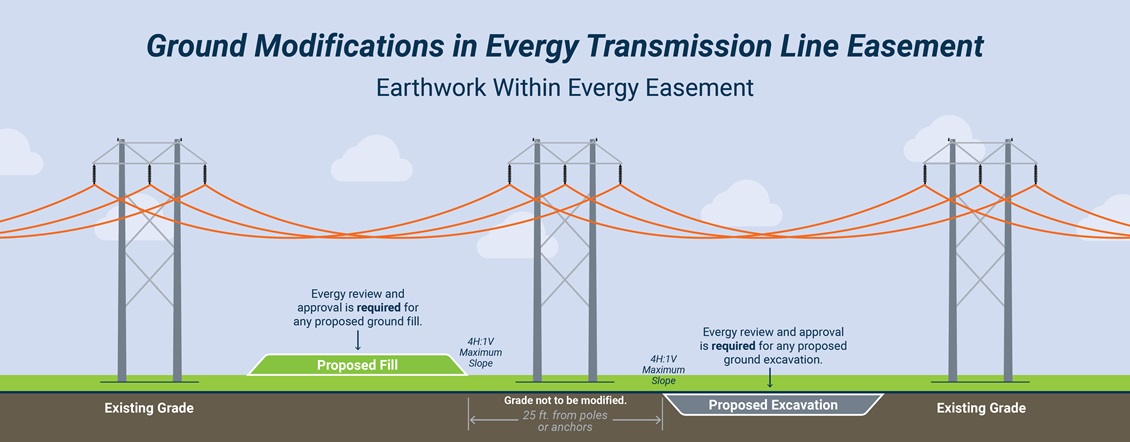
Evergy’s review and approval are required to ensure safe operations. Activities within Evergy easements may be subject to specific requirements and conditions. These guidelines help ensure the safety of workers and the public, protect utility infrastructure and support the reliable operation of the transmission system.
The following activities and conditions are not permitted, except with review and approval by Evergy:
- Operating equipment at heights greater than 14 feet
- Leaving spoils of any kind within the easement
- Storage of explosive or flammable materials, including fuels
- Blasting
Why does Evergy need to review and approve modifications within its easement?
To support the safe and reliable delivery of electricity to Evergy customers, Evergy reviews and approves planned changes within its easements to help ensure required safety clearances are maintained. The review process also helps verify that transmission structures remain protected and accessible for routine maintenance and timely response for outage restoration when needed.
Why doesn’t Evergy allow ponds within its easements?
Evergy does not allow ponds of any kind within the easement because they block access to Evergy structures for maintenance and potential future placement of structures.
Why doesn’t Evergy allow swimming pools within its easements?
Swimming pools, like ponds, restrict access and future placement of structures. Swimming pools under power lines also create potential safety hazards because water can splash upward near the wires and result in a dangerous arc flash.
Why doesn’t Evergy allow permanent structures within its easements?
In addition to containing our transmission structures, our easements encompass the area in which the line will blow or sway in the wind. Permanent structures require large safety clearances that must be maintained when the line blows or sways. Permanent structures also limit Evergy’s ability to access its easements for maintenance and future placement of structures.
Why can’t objects above 10 feet be located in the Evergy easement?
In addition to containing our transmission structures, our easements encompass the area in which the line will blow or sway in the wind. Objects must be kept under 10 feet in height to ensure they won’t be too close to the energized lines when they blow or sway.
Why does all grading greater than +/- one foot need to be reviewed and approved by Evergy?
Evergy needs to review grading plans within Evergy easements to ensure the transmission lines meet required safety clearances to the proposed ground level. Evergy also needs to confirm the grading plans don’t hinder Evergy’s ability to access its transmission lines. Graded slopes need to be drivable for construction equipment (trucks, trailers, cranes, etc.) to access the easement for future maintenance and construction. For example, grading cannot leave existing transmission structures on steep mounds or ditches where Evergy cannot access the structure.
Why do grading changes within 25 feet of an existing pole or anchor need reviewed?
Transmission line structures stand up because of the integrity of the ground around them. Grading needs to remain as is to prevent ground instabilities, corrosion concerns and exposing the structure's electrical grounding system. Evergy also needs to be able to set-up equipment next to existing poles and anchors for maintenance and replacement work.